Legacies of racial discrimination lurk in the titles of many properties throughout King County. In Federal Way, 288 homes are likely to still have covenants with language limiting the race or religion of who can live on or own the property, although these covenants are not legally enforceable.
Federal Way City Council members took the first step to helping property owners remove that language from their property’s documents in a consent agenda item on Oct. 21.
Although cities can’t do anything to remove the language because individual property owners have to take those steps themselves, educating property owners can give them the opportunity to take the time to make that change.
The council voted to “provide property owners notification of historic race and faith restrictive property covenants and outline options to property owners for their removal.”
Just one example of the type of language being referred to is the Crestview Shoreclub Addition, which includes several properties adjacent to Camp Kilworth that reads “said property or any part thereof, shall not be sold or let to or by any person of the jewish, oriental, or negro races, except that a servant not of the Caucasian race but actually employed by a bona-fide owner or resident, may reside on the premises.”
Property owners with this language will have three options to remove it:
• If there is a homeowners association (HOA), they can amend their covenants, conditions and restrictions (CCR) document to remove discriminatory covenants. This would require a majority vote of the HOA board, then a statement in the public records with specific language striking discriminatory language.
• Property owners can record a covenant modification document with the county assessor. This will allow the removal of the covenant from their property deed and strike it from the chain of title. King County has created a step-by-step guide on how to do that on its website.
• The property owner can remove all historic references in their chain of title and expunge any evidence of the past discriminatory covenants from the public record by filing an “in rem declaratory judgment action” in King County Superior Court and obtain a judgement from the court.
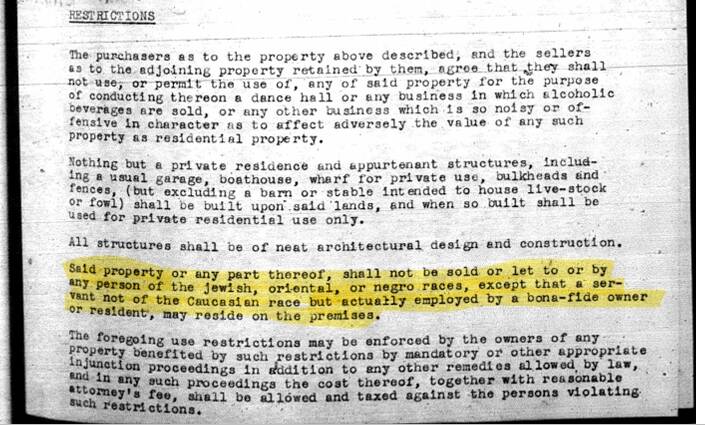
Language including racial restrictions in the original Statutory Warranty Deed of the Crestview Shoreclub, which originally consisted of 23 properties adjacent to Camp Kilworth.
History in FW
While these discriminatory covenants are no longer enforceable, the legacy of real estate racism in Federal Way still has impacts today. Areas that had racial restrictions in the city like the neighborhoods in Marine View and near Dash Point State Park still have some of the highest populations of white property owners in Federal Way, according to census records.
Council member Lydia Assefa-Dawson experienced the shock of seeing a restrictive covenant on her own property.
“I remember the experience of seeing that when we bought the house. Not knowing what that really means and how it’s going to impact me and my family was not a good feeling,” Assefa-Dawson said in the council meeting, who saw discriminatory language in the title of a house she and her family purchased in Des Moines.
“As a person of color and immigrant, that makes you a little nervous. So regardless of whether it’s null and void, the fact that we’re talking about it and trying to solve or make sure that it’s no longer in the covenants is meaningful to me at least,” she added.
Assefa-Dawson specifically shared appreciation for Councilmember Paul McDaniel’s effort to champion the ordinance that will notify and empower property owners to make changes.
“I think when we first had this conversation … you didn’t even know it existed,” she said. “The fact that he took this on himself, did the research … going from practically not knowing it exists to championing this issue is huge.”
In addition to the directly discriminatory covenants, the Federal Way Historical Society documented racism in housing practices in general.
“Federal Way real estate agents in the early 1960s had a general policy of not selling houses to African Americans,” they shared from an interview with Harold Booker in 2013. “Booker’s fellow civil rights activist and Federal Way resident, John Metcalf, remembered that this policy was usually not overtly expressed. Black persons inquiring about homes were usually met with such tactics as being told that the house was already sold (even though it was still for sale). Metcalf suggested that there were some Federal Way real estate agents willing to sell to black people. However, these agents did not wish to stir up fear among Federal Way whites that an increased black presence in their neighborhoods would cause lower property values.”
Even decades later, the lingering stench of racism was still felt by future generations, as the Seattle Times reported in 1993. This concern about “lower property values” is also the essence of the practice of redlining, which was a practice of insurance companies that would color-code areas of a city (including Seattle) by their assessed risk, then segregate the city by only allowing Black families to purchase homes in the so-called “risky” areas of the city that they outlined in red.
A public research project into racially restrictive covenants in Seattle and beyond has jump-started a variety of localized approaches to righting these wrongs.
The Seattle City Council recently passed the Roots to Roofs bill that expands housing on sites once under racially restrictive covenants.
Across the state, lawmakers and leaders have been grappling with how to address this legacy.
In Spokane, the local college is hosting a workshop for homeowners providing guidance on the same steps the Federal Way City Council plans to mail out.
The council discussed how best to disseminate the information about the covenants, especially for those homeowners who will want to understand them better. They discussed the workload of the city available for this, and Councilmember Susan Honda brought up the idea of holding a town hall event to share information directly with a group.
While some questioned the idea because they didn’t believe that attendance would be high, Honda noted that these types of events often serve as a way for the community members who do attend to be able to spread accurate information out to their neighbors and contacts.
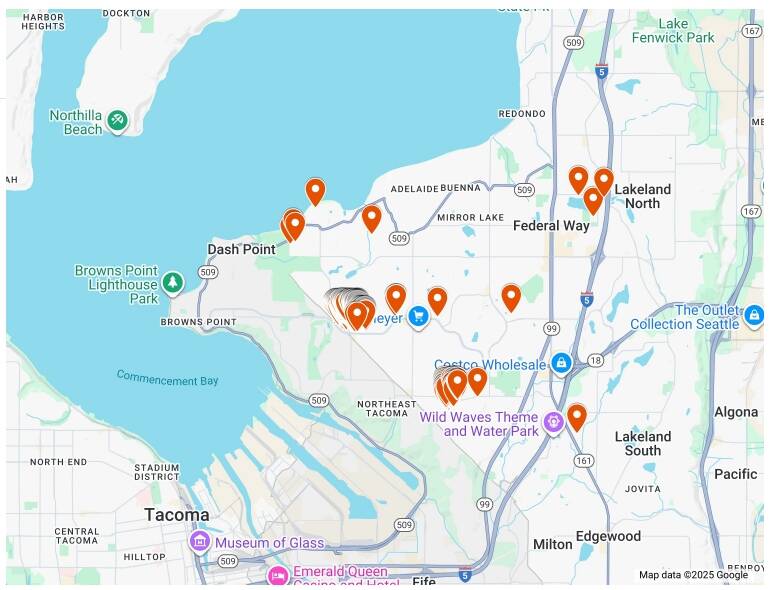
The city of Federal Way included a list of 288 properties that may have racial or religious restrictions in their documents. Those properties are mapped here. Map created by the Mirror using Google Maps.
The catalyst
Councilmember Paul McDaniel said he first learned of the racially restrictive covenants after he challenged the city staff to provide proof that marginalized groups had experienced discrimination since the city’s founding.
“I was mad about having my city called racist or discriminatory … then when I read these, it made me sick. And actually just reading these right now kind of makes me sick,” McDaniel said. “We don’t live in this world anymore. I’d like to eradicate this literally … I’m not saying make it disappear forever, not whitewash it, but I’m saying destroy this kind of concept that’s out there.”
As the council considered what their vote would be, McDaniel said to the other council members, “you may be one of the first city councils who has actually done something about this. Thank you for giving me the opportunity to talk about it and bring it forward to you guys so that we can do something. Even if only one person does this, in my mind, it’s a win. We at least did something.”
The council voted unanimously to give notice to those property owners.
As previously reported in the Mirror, the recently renamed Conna Park honoring Black pioneers John and Mary Conna is near one of these neighborhoods that built discrimination into its design.
A map of all identified locations that may have this language can be viewed here.