Racism, white privilege and Federal Way: Facing issues head-on
Published 9:00 am Tuesday, September 6, 2016
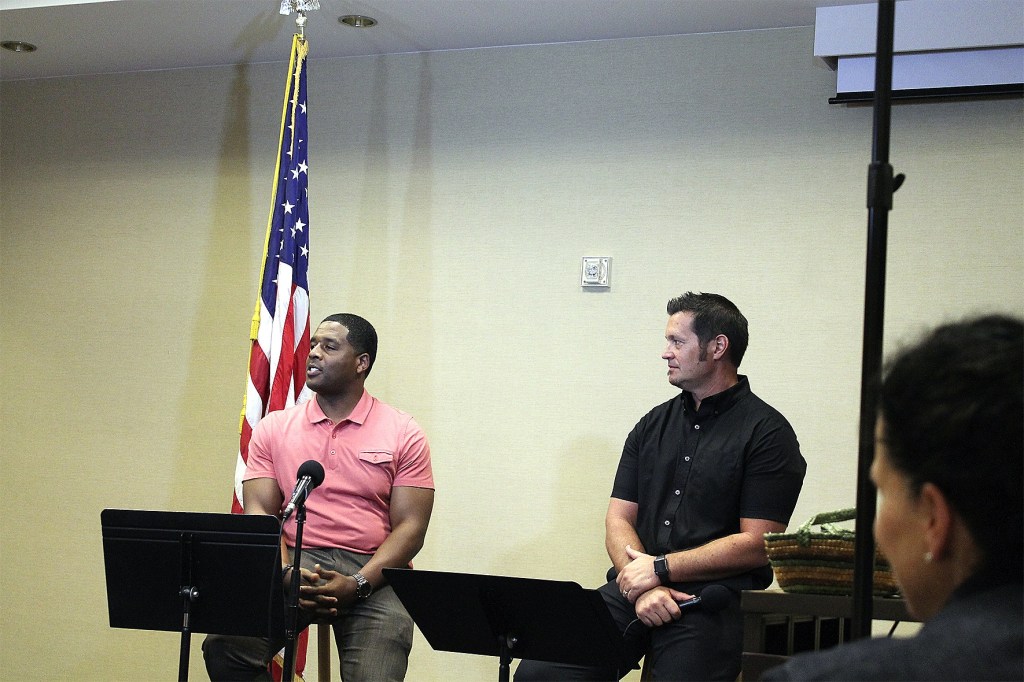
Lawrence Garrett recalled the first time he stepped foot in the Federal Way Police Department.
“I took two steps… and froze,” he said. “I was paralyzed. I couldn’t go anywhere and I didn’t know why. It was the first time in my life I experienced an anxiety attack.”
Garrett was on a tour of City Hall with his Advancing Leadership class back in 2010. He is now Advancing Leadership’s executive director and has a strong relationship with Federal Way police.
“Andy Hwang, I consider him a friend, a dear friend,” Garrett said, referring to the police chief. “Someone I can confide in.”
But seeing police officers with guns triggered fear and took him back to his time in Los Angeles.
Between the ages of 15-17, Garrett said he was pulled over nearly 10 times. Police have drawn guns on him a handful of times, frequently searched his car and asked if he had warrants out against him.
“Not once did I receive a ticket,” Garrett said. “Now, mind you, I was the ASB president of my high school – not that it matters – but I was an honor roll student.”
The experience took him on an introspective journey to learn why he felt the way he did, and to find ways to mend the anger and hurt he felt from his past.
“I have justification where my stance was with the police department,” he said. “It’s not because I read it an article, it’s because I lived that. But I want to share this with the nation, with people: You can’t stay there. None of us, we can’t stay there.”
Garrett was one of two speakers who addressed the concept of “Black Lives Matter” at the Rotary Club of Federal Way’s meeting on Thursday, Aug. 18. Jon McIntosh, the lead pastor of Grace Church, was a speaker as well.
The two were there to talk about systemic racism, why black lives matter, too, and the white privilege that too many don’t realize exists.
McIntosh said effecting change should not be done in isolation, but in partnership.
“It requires empathy, which is the ability to understand the feelings of another, and empathy requires proximity,” McIntosh said, emphasizing why it was important for people to hear Garrett’s story.
And as Garrett learned about why he had that anxiety attack through therapy, he came up with the phrase, “I wish they knew me.” But he also discovered the power of vulnerability.
He turned his frustration into a fascination.
“That curiosity got me to empathize, because in proximity, I got closer to people, perspectives, situations that were unfamiliar to me,” he said. “Because of my perspective that is broadened, I have a responsibility to challenge those that I love dearest and that are closest to me.”
Garrett said those are his hardest conversations.
Garrett told the crowd he and McIntosh “go far back” and often talk to each other about complex issues such as politics, culture and religion, but when they do so, they come to listen, not to talk.
McIntosh said, speaking from a white perspective, that it’s important to listen to those behind the Black Lives Matter movement.
“Many of my friends are very comfortable saying ‘all lives matter,’ and they’re very comfortable saying ‘blue lives matter,'” he said. “In fact, when I hear someone say ‘black lives matter’ and they say, ‘You know what? All lives matter,’ they feel very good about that because all lives do matter.”
But McIntosh pointed out some people feel comfortable saying “all lives matter” and “blue lives matter” but not “black lives matter,” it’s indicative to him that “black” is the issue.
When someone in the “dominant culture,” refuses to listen to someone who says “black lives matter,” they’re communicating that African-American’s experiences and stories are not valid, McIntosh said.
McIntosh said his friends in the African-American community point out the phrase is meant to convey “black lives matter too,” not more.
“The reason I’m saying ‘black lives matter’ is because our cultural environment right now does not play out in a way it would say to the black community. ‘You’re as important as the white community,'” McIntosh said. “It simply doesn’t.”
McIntosh said he recently learned that African-American students are testing below and under-performing when compared to white students.
“If that’s happening across the board, we either have a genetic issue or a systemic issue,” he said. “Does anyone in this room want to make the case that African-American students are genetically inferior to white students? We have a systemic issue.”
Superintendent Dr. Tammy Campbell later commented that seven out of 10 Federal Way Public Schools students are students of color, yet their ethnicities are often underrepresented at community meetings she attends throughout the city.
“They’re the future of our city,” she said. “I think often we go to the extremes of what happens when it gets really bad, but I think we need to think about it being in the ‘gray.'”
She said that’s the part this city can begin to think about – is there space for the folks of the future?
“The parents of our children don’t show up,” she said. “And I think this conversation has something to do with that. Not just the African-American community, but our Latino community, and various communities.”
Campbell said she thinks the conversation McIntosh and Garrett were able to have is important for everyone to think about.
“I think the very life of our city depends on it,” she said.
McIntosh said white people have an ingrained privilege that uplifts them and suppresses others. And while white people can’t change that privilege, it is their duty to be aware of it. The concept was written about in 1988 by a woman named Peggy McIntosh (no relation) in “White Privilege: Unpacking the Invisible Knapsack.”
“White people are slow to let go of power because white people benefit from the power they have,” McIntosh said. “And systems, society, is set up right now where, if you’re white, you start the race not at the starting line but by the 25-yard line, probably the 50-yard line.”
McIntosh and Garrett handed out Peggy McIntosh’s “invisible knapsack” of ways white people benefit from their privilege, and Garrett offered another source: “The Invisible Man,” by Ralph Ellison.
Not much time was left for questions and answers, but Rotary President Layne Barndt said there will be another meeting in the same vein as this one.
“I think this is a great start, and we’re hoping to lead the beginning of change,” he said. “Everyone loved it and they want to do it again.”
Federal Way Mayor Jim Ferrell said he thought the discussion was “excellent,” and said that although these kinds of conversations are sometimes difficult to have, respect and communication are the basis of all good relationships.
“This actually took a lot of courage to have this conversation, and while awkward and sometimes difficult to start, it’s so important to our community,” he added.
Campbell said it’s important to create space where the community can talk about issues that have the potential to divide so that they can “work together and have a vibrant, healthy community where everybody can participate and benefit fully.”
Federal Way Public Schools Board of Directors President Geoffery McAnalloy said, as a “white privileged male,” it’s his responsibility to take the first step forward to make sure they take care of all students.
“When they walk into the building as kindergartners, they are welcomed no matter what color their skin is and that they feel welcomed and safe,” he said. “It has to happen if we’re going to make a difference in helping that achievement gap go away.”
The Rotary plans to have another meeting to continue the conversation on Sept. 15. For more information, visit www.federalwayrotary.org.