Council delays voting on Federal Way’s opioid settlement spending
Published 2:30 pm Monday, July 7, 2025
In King County, 25 cities are slowly receiving a total of more than $121 million from lawsuit settlements against national pharmacy chains for their role in fueling the opioid crisis.
The lawsuits asserted that “the pharmacies served as the last line of defense in the opioid supply chain and failed in their collective responsibility to prevent the overuse of opioid prescriptions,” according to a 2022 announcement.
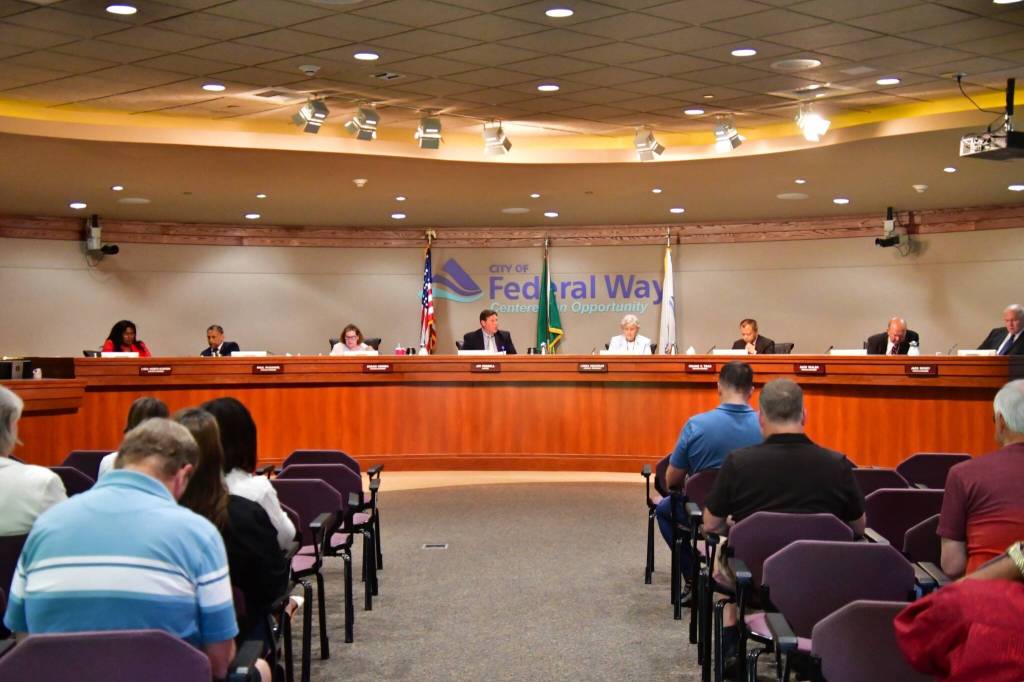
At its July 1 meeting, the Federal Way City Council considered supporting two small changes to the interlocal agreement that governs how the spending of these funds is overseen.
The council decided to delay approval of these changes after several members expressed that they didn’t understand the agenda item.
The agenda item specifically includes approval of two changes requested by the Opioid Abatement Council (OAC) to an interlocal agreement around the functioning and efficiency of their work.
The agenda item has been forwarded to the July 15 council meeting, where councilmembers will vote on the requested changes by the OAC.
About the OAC
The OAC was established to oversee how cities spend their opioid settlement disbursements and is required as part of the settlement.
One change proposed by the OAC is to get rid of a requirement to return unused administrative funds to cities yearly.
This current practice has been found to be impractical for two reasons.
First, opioid settlement disbursements are not spread out equally over time, as originally thought. Instead, jurisdictions have received much larger disbursements in 2023 and in 2024 than expected.
Second, the administrative burden will not be equally spread over the next 13 years because cities are not spending the entirety of their fund disbursal the same year they receive it.
So far, 10 cities have already spent or allocated at least a portion of their disbursed funds on programs to benefit the well-being of the community.
All cities within the interlocal agreement pay 10% of their disbursement each year to the OAC for administration. The change the OAC is requesting is that instead of returning the portion of these funds that are unused at the end of each year, they could hold them for future administrative costs in order to match the actual workload and administrative need as it fluctuates over time.
Unused funds would still be returned to cities, but not on a yearly basis.
The second change proposed by the OAC is to alter the contract amendment process to make it easier to make changes without waiting for approval from all 25 member cities.
This change would make it so member cities must still be notified and can object to any proposed changes, but without objection, the changes can be automatically adopted.
Federal Way’s funds
As of the July 1 meeting, financial manager Steve Groom shared that Federal Way has received $476,000 of a total projected payment of $1,406,564 from opioid settlement funds.
Unlike Auburn, Covington, Kent, Kirkland, Lake Forest Park, Maple Valley, Mercer Island, Redmond, Seattle and Tukwila, none of these funds have yet been spent or even allocated on programs to help the Federal Way community affected by the opioid epidemic.
These funds can be used for a variety of opioid remediation uses, including these suggest core abatement strategies (Schedule A in Exhibit E of the settlement):
• Naloxone or other FDA-approved drug to reverse opioid overdoses.
• Medication-Assisted Treatment (MAT) distribution and other opioid-related treatment.
• Pregnant and postpartum women.
• Expanding treatment for neonatal abstinence syndrome (NAS).
• Expansion of warm hand-off programs and recovery services.
• Treatment for incarcerated population.
• Prevention programs.
• Expanding syringe service programs.
• Evidence-based data collection and research analyzing effectiveness of the abatement strategies within the state.
So far the council has not taken any action at any public council meeting to explore the use of the funds in their possession to respond to the impact of substance use on community members in Federal Way.
At the July 1 meeting, Mayor Jim Ferrell confirmed this, saying “we’ve already had $400,000 of money disbursed to the city for this purpose. This will obviously be a good opportunity for us to talk about how we should start thinking about investing that money.”
The last time the council had an agenda item related to the opioid settlements, it was over a year ago on May 7, 2024, as previously reported by the Mirror.
At the 2024 meeting, Councilmember Linda Kochmar asked about creating a treatment center for those suffering from substance use disorder with the funds. Councilmember Susan Honda asked if funds could be used to help babies that are born addicted to drugs.
At the July 1 council meeting, Honda again mentioned the needs of drug-exposed and medically fragile newborns in a separate comment. Specifically, she mentioned that the Pediatric Interim Care Center (PICC) in Kent has lost funding with this year’s state budget cuts and will be closing after 35 years.
PICC is the nation’s first interim care nursery for drug-exposed and medically fragile newborns.
While Honda didn’t suggest specifically that opioid settlement funds be used for this purpose at that meeting, this facility relates to a core strategy and suggested use for those funds.
Council discussion
In the July 1 council meeting, councilmembers brought up several questions they wanted answers to before they felt comfortable voting on the OAC contract changes.
The answers to most of their questions are on the main page of the OAC website, which can be found at kingcounty.gov/oac.
Councilmember Jack Dovey asked, “how many people are administering this and how much does it cost?” and also asked for numbers around “cash flow” to understand how the allocated administrative funds were being spent.
In regards to the costs of administration, City Attorney Ryan Call explained the 10% for administrative costs is “actually pretty standard” in this type of settlement and reminded Dovey that “it’s not our role to audit them” because that is something that already happens at the state level.
Honda also asked about who is on the OAC, and specifically why Auburn was selected as the city to represent the many other cities receiving settlements.
The OAC includes four government representatives based roughly on the percentage of regional funding received.
The two members from King County include Brad Finegood, Public Health – Seattle and King County and Dan Floyd, Department of Community and Human Services.
The City of Seattle representative is Jeff Sakuma.
The fourth government representative is actually from the organization Sound Cities Association (SCA), which represents the other 24 cities included in the settlement, including Federal Way.
The City of Auburn’s Kent Hay was selected to represent SCA and therefore these other 24 cities. Hay also represents the SCA in his role as an advisory board member of the South King Housing and Homelessness Partners (SKHHP), and is a member of the Governing Board of the King County Regional Homelessness Authority (KCRHA) as well as the Director of Human Services for Auburn.
Public Health of Seattle and King County also serves as the administrator of the OAC and has responsibilities including: receiving and maintaining expenditure reports and other data from parties utilizing settlement funds; maintaining and updating public data dashboards; maintaining OAC records; preparing annual accounting of OAC administrative expenses; and reporting to the National Trust as required.