Over 80 volunteers in Federal Way have completed the Community Emergency Response Team (CERT) basic course since the program was restarted in 2023. Twenty of them have even stayed on to become on-call volunteers for the program, doubling the city’s crew in those two years.
Federal Way community members have the opportunity to do the same by signing up for the free basic course, which begins on Sept. 17 and will run through Nov. 12, every Wednesday from 6 p.m. to 8 p.m. at City Hall.
Whether participants go on to become volunteers after completing the course or not, “everyone who completes the program is better able to be self-sufficient in the event of a disaster, and they have the skills to help their family and neighbors,” Federal Way Emergency Manager Kevin Pelley told the Mirror.
When the Mirror reported on the classes in 2024, several participants shared they decided to attend because they just want to be able to help their neighborhood and church if anything happens. Others shared that their anxiety pushed them to attend, and the course helped them better understand what is actually an emergency and made them more confident that they could respond if needed.
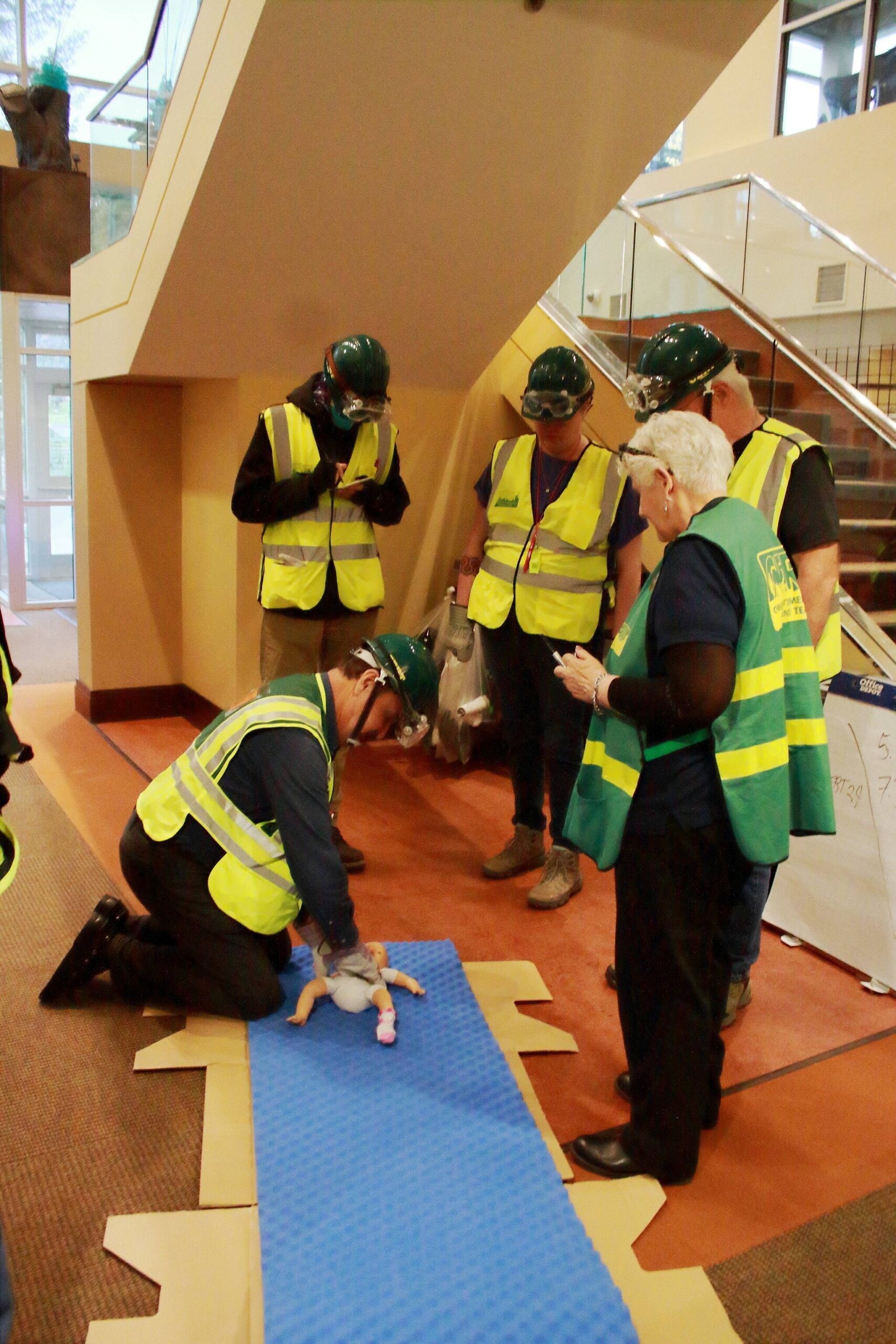
CERT student volunteers practice responding to an emergency situation involving an injured baby in 2024. Photos by Keelin Everly-Lang / the Mirror
The Greater Federal Way Community Emergency Response Team (GFW CERT) “provides residents of the Greater Federal Way Community with disaster preparedness skills to protect themselves, their families, and their neighbors, and the skills and organizational structure to respond to the immediate needs of the community, supporting first responders in the event of an emergency or disaster.”
The basic course starting on Sept. 17 will include the following topics: disaster preparedness, CERT organization, disaster medical, fire safety and utility control, light search and rescue, terrorism and disaster psychology and practical exercises.
While the course itself hasn’t changed in the last two years, local programs can add to the curriculum and tailor it to local specific hazards. In Federal Way, this includes possible hazards and disasters like an eruption from Mount Rainier, earthquakes or severe winter storms, according to Pelley.
Pelley shared that the CERT program has two critical goals — first “to provide training and education to our residents to help them and their families prepare for and respond to an emergency,” and second to “train a pool of volunteers to help relieve overwhelmed first responders in the event of a disaster.”
In addition building up their toolbox of emergency skills, Pelley said each CERT member is also encouraged to build up their physical preparedness as well and be “two weeks ready” with food, water, batteries, medicine and other essentials — and to have their “go bag” in case they have to evacuate suddenly.
Each student volunteer will receive a CERT backpack and a certificate of completion.
While individual CERT programs are managed locally, the Federal Emergency Management Agency (FEMA) develops the courses and provides in-person training for emergency management experts at their Emergency Management Institute in Maryland.
National challenges to FEMA funding delayed funds for a few months from the Emergency Management Performance Grant (EMPG) allocation in Federal Way, but those funds were released in June, according to Pelley. Next year’s grant was also approved.
Funds this year were used to purchase drones for search and rescue, or to conduct damage assessment after a major disaster, Pelley said.
The city also purchased equipment to outfit two mobile communications platforms, which will provide radio, cellphone and internet service anywhere in the city even if all power, phones, cell towers and radio repeaters are down, Pelley said, adding that: “We can use these to provide radio coverage to first responders, or WiFi and cellphone service at an emergency shelter or aid distribution center.”
Pelley took over the role of emergency manager for the city in 2023, and since then has been working with local partners to strengthen their ability to coordinate during and following a disaster.
Since 2023, they’ve “held several Emergency Operations Center training sessions and practical exercises to ensure we could assess the situation, develop a coordinated plan, and work together to prioritize resources and responders to save lives and property. This past year, we focused on the city’s ability to provide essential services to our residents in the event of a major disaster that could cut power, water, communications and roads for an extended time,” Pelley said.
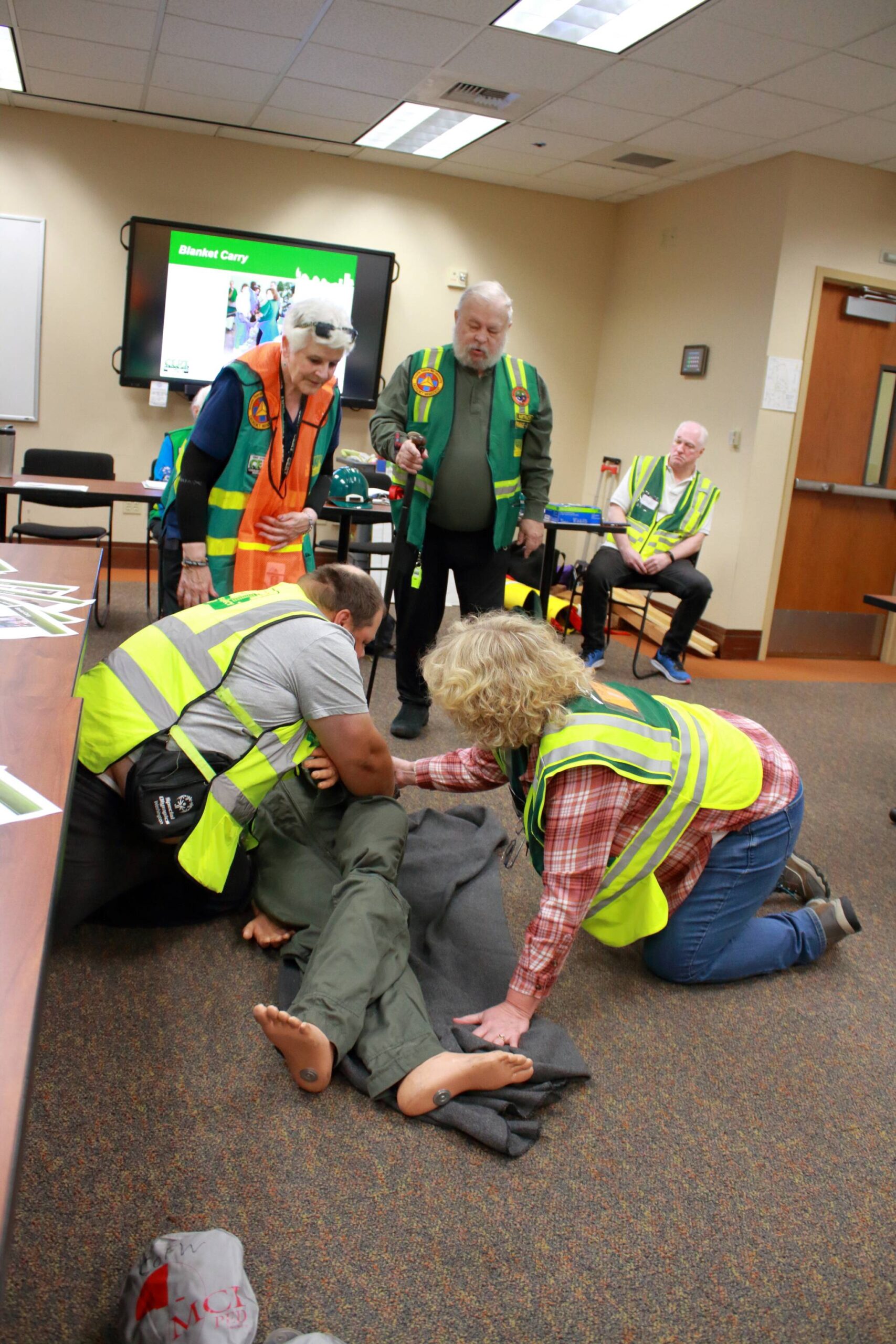
Volunteer students learn about how to use a blanket to carry someone who is injured or can’t move on their own at a CERT Basic Course in 2024. Photos by Keelin Everly-Lang / the Mirror
Partnership with first responders
Community members with emergency training can make a big difference in keeping the community safe in partnership with first responders.
“When residents are trained and prepared through programs like CERT, it makes the entire community stronger,” Capt. Brad Chaney of South King Fire told the Mirror in an email. “In a large-scale emergency, first responders can be quickly overwhelmed, so having neighbors who know how to help themselves and others buys valuable time and saves lives.”
Chaney added that for South King Fire, “informed and prepared citizens are true partners in resilience. They extend the reach of emergency services and help us focus resources where they’re needed most.”
This proved to be true in Los Angeles in fires this year where members of the LA Fire Department CERT team supported efforts in the Palisades, Hurst and Sunset fires and also brought needed supplies to those fighting the Eaton fire outside of their perimeter.
The LA Fire Department’s CERT is the oldest and one of the largest in the country, and Pelley told the Mirror that because the national FEMA curriculum was based on their work, the Federal Way program is also modeled on their program.
This year during these widespread fires, supportive efforts were conducted by a specialized group of civilians called the LAFD CERT Call-Out team, who are more highly trained than even those on the general CERT team.
They helped with meal service, supplying needed equipment, cleaning up incident command efforts, escorting residents to see/salvage items from destroyed homes, managing donation collection and distribution and more, all while navigating dangerous conditions.
The Federal Way version of this specialized team is called the Crisis Action Team (CAT) and has 30 members, up from 13 when the Mirror wrote about CERT back in 2024.
The CAT team is made up of volunteers who are willing to receive a call after a disaster. Pelley said the team includes those of all ages and abilities, many of whom have specialized skills like working in the Emergency Operations Center. In general these volunteers would be called on to help with tasks like filling sandbags, running chainsaws, conducting light search and rescue, or whatever the first responders need help with that aligns with individual skills and abilities.
In the case of a similar disaster in Federal Way, the local program is much smaller than the LAFD CERT and so it isn’t prepared to do everything that the LA version did. But “our team members are more than ready to assist at command posts, distribute aid, and operate shelters just like the LA CERT CAT members did,” Pelley said.
This expansion of skills can be developed during the Greater Federal Way CERT meetings that happen every first and third Wednesday of each month when the basic course is not in session. Everyone is welcome to attend. It is held from 6 p.m. to 8 p.m. on the first floor of City Hall in the Patrick Maher Room.
To sign up, email or call Sharon Green at sharon.green@federalwaywa.gov or 253-835-2712.
National Preparedness Month
While attending the basic course is one way to get prepared for emergencies, Pelley said that this September, the city is encouraging community members to do four things even if they can’t attend:
• Sign up for emergency alerts through ALERT KingCounty. They can get local alerts for their home, work and school. Also, download the app for MyShake Home to get advance notification of earthquakes. The “big one” could hit off the coast and MyShake gives a couple of minutes warning — enough time to duck, cover and hold on before it hits.
• Make a plan. Know how to get ahold of your family and loved ones in an emergency. Plan on where to meet if you’re separated at home, work, school, or shopping.
• Have a “go bag” prepared and ready in case you need to leave immediately. Hazardous material spills like the one in the train derailment in East Palestine, Ohio, in 2023 can happen anywhere. Having a “go bag” by the door and one in their car ensures residents are able to evacuate with the food, medicine, toiletries and other essentials they need. Everyone’s bag will be different, depending on if they have pets, small children, or people with special needs.
• Be “two weeks ready.” Have enough food, water, and other critical supplies to hunker down and sit through a major disaster. An earthquake, eruption of Mt. Rainier, severe storm, or other disaster could cut power and roads, preventing residents from leaving their homes, or preventing suppliers from delivering food and gas to the area. By having everything they need at home, people in Federal Way can safely sit it out without relying on the government or volunteer agencies.
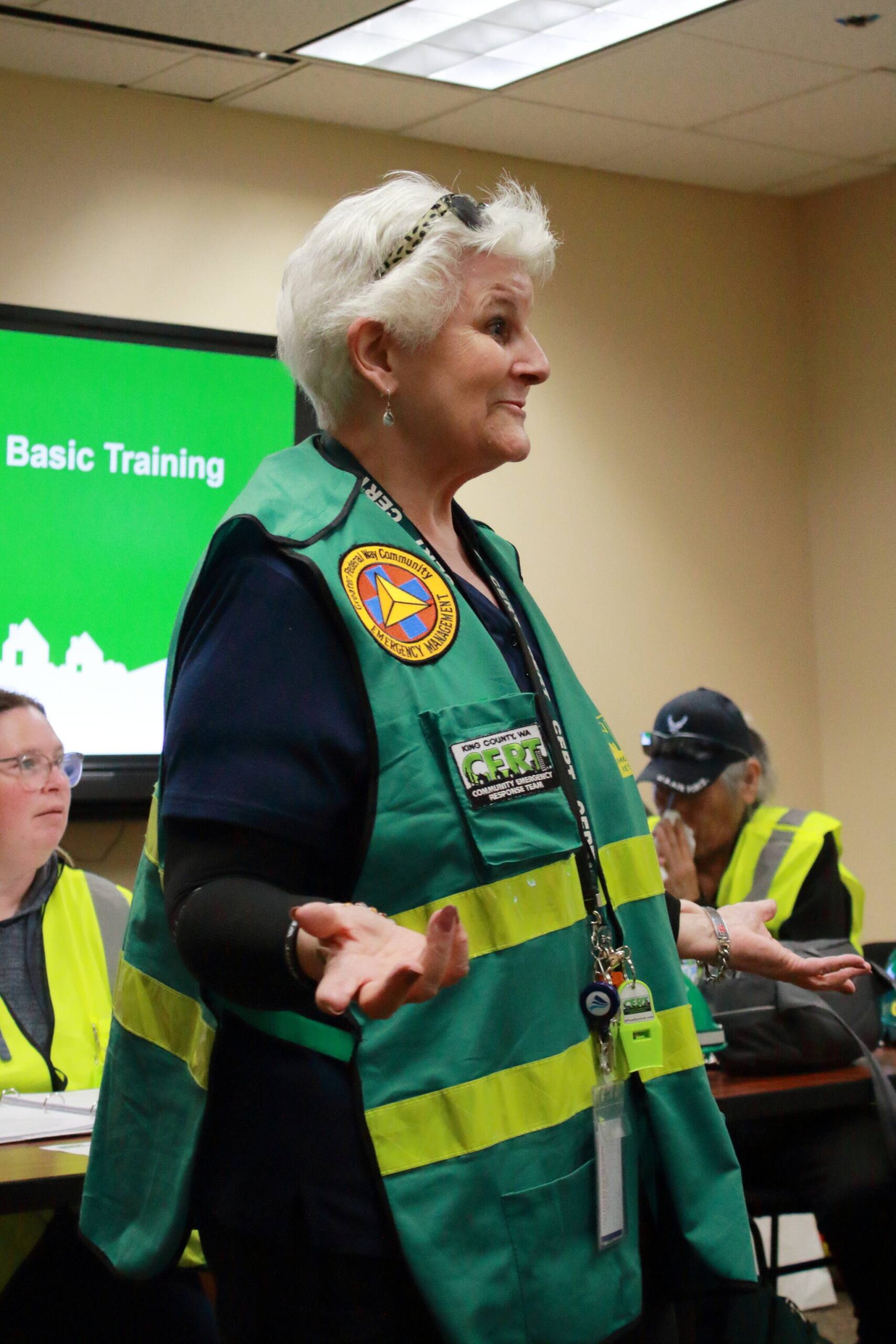
Sharon Green leads instruction at a Basic Course of a CERT class in 2024. Photos by Keelin Everly-Lang / the Mirror