Federal Way fire commissioner candidates sound off on bond failure, transparency
Published 5:02 pm Thursday, July 9, 2015
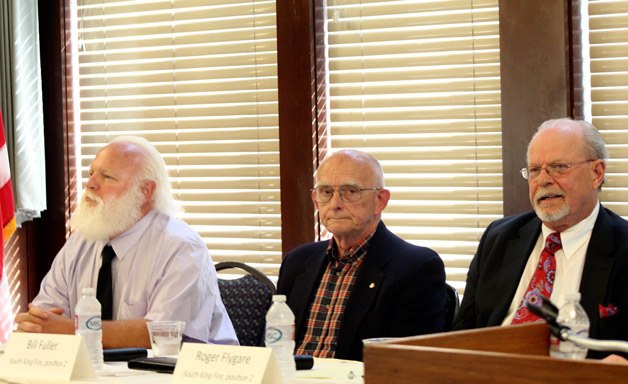
Candidates for South King Fire and Rescue’s commissioner Position 2 sounded off on topics ranging from the district’s recent bond failure to transparency and nepotism during the Mirror’s candidate forum on Wednesday night.
Longtime campaigners Roger Flygare and Jerry Galland, as well as political newcomer Bill Fuller addressed approximately 60 people during the forum, which was held at the Twin Lakes Golf and Country Club. They are running for longtime commissioner Mark Freitas’s open seat as he is not seeking re-election.
Flygare attributed the failure of the fire district’s recent $53.7 million bond to voter confusion.
In addition to South King Fire’s measure — which would have replaced equipment, facilities, vehicles, as well as fund an additional fire station and fleet maintenance shop — King County also had a Proposition 1 on April’s special election ballot to fund the region’s emergency public safety radio network. The King County measure passed.
“I also heard comments and talking to people that there might have been too big of an ask,” said Flygare, who was on the pro-committee for South King Fire’s ballot measure. He added that fire commissioners have also heard this concern and plan to come back with some different ideas about how to go forward with potentially putting two new propositions before the voters — one this year and another later.
Galland agreed that the bond’s price tag was too high, however, he said the measure didn’t fail because of any confusion.
“I believe the bond measure failed because the district was asking for too much and it was a surprise to the voters,” said Galland, who was on the con-committee for the measure. “The preparation that went out on that was very short. (The district) indicated that they were going to hold a lot of public meetings and they didn’t. They didn’t get out in the community and share the need. So a lot of what was going on — you can mention confusion on the ballot — but it was a raise in taxes and it was a large ask, it was a very large ask and I don’t believe the community knew what that was going to go towards.”
Fuller agreed with Galland that voters were unaware of the bond issue. He spoke with some of his neighbors, who “were really not aware of what the issues were and I’m not sure that they were communicated well … We’ve got some equipment age issues and we need to solve some of those. The public needs to be aware of what the issues are and that they are getting a tremendous bargain.”
So how would the candidates maintain the fire department’s equipment?
Flygare held up his wrist.
“This watch here — talk about buying quality equipment — this is a watch that I bought in 1970 in Saigon, Vietnam,” he said, as the audience laughed. “These shoes that I have on right now I bought for my wedding day, 1976. So having good equipment that lasts a long time is very important.”
Both Flygare and Fuller support the fire district establishing its own in-house maintenance shop, as they said contract maintenance is costly.
Fuller said if he’s elected as commissioner, he will focus on preventative maintenance of the district’s equipment.
“I spent most of my career working in pulp mills and the real goal is preventative maintenance because when you have breakdown maintenance, it’s very expensive,” said Fuller, who worked at Weyerhaeuser for 35 years as a senior scientific advisor and other capacities.
All three candidates acknowledged that the district has antiquated equipment.
However, Galland said the fire agency has had opportunities in the past to use existing revenues to purchase equipment.
“We haven’t done that,” Galland said. “Instead, we’ve come to the voters in this big bundle activity … So equipment is vital, it needs to be there, I think there’s a direction that it should have gone and it hasn’t.”
The candidates also addressed how they would work cohesively with other commissioners, while not being a rubber stamp for the district.
Flygare said as a small business owner, he’s a state and federal contractor. To be successful in his court reporting business, he said he has to do his research, build his budget, look at equipment and “analyze as you move along.” He said he’s been successful doing that “and the people that I work with appreciate that. And I’ll take that skill with me to the fire department. I think it’s really important that you know how to work with people.”
Galland, a longtime South King Fire activist, emphasized he is not a rubber stamp.
“I believe that one of the things that helps to make things happen in the district or any organization, especially a public agency, is the viewpoints opposing what you might believe is the absolute God-given truth on something,” Galland said.
He said he respects Freitas for issues he’s faced as a commissioner, especially in the past year, due to a lack of cohesiveness on the current board.
“I believe that I can do a lot on the board that I can’t do from the audience,” Galland added. “I’m going to be more vocal than Mr. Frietas was. I’m going to be a little bit more insistent that Mr. Freitas was. And the citizens are demanding that already. You’re seeing that in the bond failure. They need answers, they need information they’re not getting, so they’re asking for a citizen to step forward and do that and I’m volunteering. I’m stepping into the hornet’s nest, if you will, and I will not be a rubber stamp.”
Fuller would bring his skills in conflict resolution and problem solving to the board. He said one of the key things in problem solving is gathering all the facts and data, analyzing those facts, working at creative alternatives “and then discussing them and discussing them some more.”
However, Fuller said as he looked at the minutes of past commissioner meetings, “it’s very difficult to evaluate discussions and whether things are rubber stamped … I’ve seen a little bit of discussion, but I’d like to see more of that kind of analysis, reports made available, lots of data — as a scientist, a lot of data. I spend all my time analyzing data. That’s what we have to do, whether it’s maintenance or statistics on responses.”
To improve transparency on the fire district’s board, Fuller said he would form committees and involve the public to draw knowledge from them.
“The transparency will come simply because the commissioners know it’s important and they can do it through more frequent communication, through TV,” Fuller added. “I haven’t seen the department featured on the local TV what a good job we’re doing. We have a fall program that is working on fall prevention … but it needs to get out there and be made known. It’s not transparency about what’s wrong; it’s transparency about showing folks what is working and why our department is doing so well.”
Galland said he doesn’t believe anyone “in the history of this fire department has asked for more public records than I have. A lot of that is because I need to — you need to. If you want to see (the records), you need to go and request them because they don’t tell you about them. They don’t tell you about committee meetings, they don’t tell you about a lot of activities. They don’t even keep minutes of their committee meetings like you have with the City Council. So if you want to find out what’s going on in the district, you have to ask questions because they’re not open and accountable. I believe that I can change that.”
Galland said if elected he would ensure the fire district’s committee meetings were posted on the district’s website and reports of those meetings were made available to the public.
Flygare said if the fire district has a problem with transparency, then the department could take steps to make its committee meetings open to the public by videotaping the meetings and posting those videos to the district’s website.
“That seems to be a very simple thing to do and then people wouldn’t have to necessarily troop down to the fire department where they hold their meetings, but they could watch them on the website and offer input after that,” Flygare said. “I haven’t heard of any real significant problems.”
South King Fire has recently faced issues involving nepotism and the candidates addressed their viewpoints on the matter.
Both Fuller and Galland agreed that the district should avoid nepotism.
“I’d avoid it if I can. Only if there’s an exceptional skill that you need to bring on board would I go against that,” said Fuller.
Galland said one of the biggest problems with nepotism is that it creates a perception problem with the public, who may perceive it as favoritism.
“ … As far as bloodlines, I don’t believe that that should be there,” Galland said. “I think that if you want to be a firefighter, there’s other fire district’s that you can go be a firefighter in; you don’t have to be in your parent’s district.”
Flygare addressed the issue directly with fire department officials.
“I was told that there is no direct-line supervision to family members of the few family members who might work there,” Flygare said. “If there is direct supervision and there is a conflict there, then that could be bad but I was assured talking to the fire department that doesn’t happen. It’s just rumors that we hear and that’s not good.”