From dark to light: South King Council of the Blind moves meetings to Federal Way
Published 10:30 am Friday, October 14, 2016
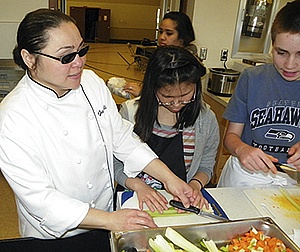
As a kid, Gaylen Floy’s parents noticed she was night-blind.
“Eye doctors didn’t know what to make of it,” she said. “I wasn’t diagnosed until after my senior year of college.”
Floy learned she would slowly lose her vision through retinitis pigmentosa, a disease that causes retinal degeneration. It didn’t seriously affect her until 2003, after working for 27 years as a graphic designer. The last newspaper she worked on was in Illinois.
“I started noticing sudden vision changes,” she said. “I thought my glasses weren’t right.”
Doctors thought cataracts might be the problem, but corrective surgery solved nothing.
Floy’s retina was failing. Doctors told her it was time to “figure out some life changes.”
“It was a really tough adjustment,” she said, noting that she still has her central vision but doesn’t have peripheral vision and can’t see in some lighting. “Nobody wants to give up the car keys and nobody wants to be seen with a white cane.”
Fast-forward to present day: Floy is the president of the South King Council of the Blind, a chapter of the Washington Council of the Blind. She started the chapter with four other people – Maida Pojtinger, Telea Noriega, Ron Frederickson and Jan Klerekoper – in 2005.
Not only is she an independent contractor who teaches people with vision loss how to use the computer, she’s an advocate for people who have spent their whole lives blind as well as those who are experiencing vision loss for the first time.
“People come to our luncheons, meetings, who don’t know where to turn for services,” Floy said. “Some are afraid to leave their apartment. But we get to know them and we get them connected, and you can see, over time, a change in the person as they gain skills and confidence.
“They kind of get their life back.”
The Council also helps people with vision loss find employment and provides access to information about blindness and vision impairment.
“We focus on tackling those things and helping people learn how to advocate for themselves,” Floy added.
The South King Council of the Blind recently moved their meetings from Burien to Federal Way – 10 of their 25 members live in the area. Every second Saturday of each month, the group meets at the Denny’s near the Federal Way Transit Center.
Keeping the meetings near public transportation is vital, as navigating the system is one of the main issues facing people with vision loss, Floy said.
To help with that, members worked with the city of Federal Way to install audio pedestrian signals near the transit center. Floy said a member is in the process of trying to get another audio signal installed at the intersection of 23rd Avenue South and South 320th Street.
Marlaina Lieberg, vice president of the Council, agrees transit is a huge challenge for the visually impaired community.
“It just really upsets me when I hear people who can drive and do drive talk about how they don’t want to subsidize public transit,” Lieberg said. “Well, not everyone can see to drive. I like to say the bus line is my lifeline.”
Lieberg said access to employment for the blind and visually impaired is about as important as access to public transportation. According to the National Federation of the Blind, about 60 percent of working-age adults with significant vision loss were unemployed in 2013.
“That says to me society is still terrified of blindness,” Lieberg said. “Society has yet to come to the understanding that blind people are every bit as capable doing a job for which they’re qualified.”
Lieberg has been with the Council for about nine years. She’s served on the board of the American Council of the Blind for 12 years and has been an advocate for disability rights for more than 40 years.
She’s also been blind since doctors placed her in an incubator as a 2-pound, premature infant. She said the excess oxygen in her incubator “burned out” her retina, a common occurrence for premature babies in the 1940s and early 1950s before the consequences were discovered.
Lieberg said escaping the perceived stigma of being blind is a constant challenge.
“Even still, to this day, I will be with my husband in a store – my husband is sighted – and someone will come up and give him eye contact and then he’ll say to me, ‘Move to your right,'” she said. “I’ll say, ‘No because they need to talk to me, not you.’ People still have this belief that blind people are different, and they don’t know we go to movies, watch TV or go to sporting events. It’s sort of the attitude about blindness that we are still working to change.”
Lieberg said she believes people look at those who can’t see and think, “Oh my god, I could never do that.”
“So right away that puts you in a different place, psychologically – ‘I could never be like her,'” she said. “And that’s what I’ve dedicated my life to changing.”
Lieberg said she is “constantly energized” by the people around her who are working toward the same goals.
“I just look at some of the amazing things that other blind people have done,” she said. “I have great respect for the blind guy who climbed Mount Everest.”
Floy said vision impairment affects everyone: young, old, rich and poor from anywhere around the world. The chapter includes people from Iraq, Vietnam, East Africa and those who speak Spanish as their first language. One member had his own real estate business before he lost his vision to diabetes, she said.
And while most people lose their vision as they age, usually due to macular degeneration or diabetes, Floy said the Council is looking at creating a student summit so parents will have a way to connect and share resources with each other as they learn how best to accommodate their children.
They’ve already sponsored King County’s first Beep Baseball team – the Seattle South King Sluggers. Beep baseball utilizes a beeping ball, buzzing base and is for players who are visually impaired.
“This isn’t all dark,” Lieberg said. “Being blind doesn’t mean you have to sit in a chair. We’re here to help, hold your hand and walk you through the darkness of, ‘Oh my God’ to the brightness of, ‘Oh, there are resources.'”
Floy said all are welcome to join the South King Council of the Blind, which meets from noon to 2 p.m. on the second Saturday of each month at the Denny’s at 2132 S. 320th St. Their next meeting will be from noon to 1:30 p.m. on Saturday, Oct. 8, in the back room of Denny’s. For more information, visit www.southkingcounciloftheblind.org.