One Night Count volunteers see 150 percent increase of homeless in Federal Way
Published 3:07 pm Wednesday, February 3, 2016
N’Guy Hughes has been homeless multiple times in his life.
At 41, he’s been forced to sleep in shelters during the holidays. He’s paid health and fitness club membership dues just so he could use the facilities’ showers, and he’s slept on county buses.
“Whatever in life has come into your hand, you just have to deal with it and keep the faith that something is going to happen to you,” Hughes said.
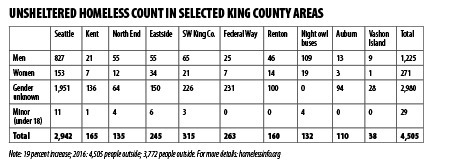
Hughes has housing now, but stories like his have increased dramatically in Federal Way within the last year. This year, volunteers with One Night Count – an annual, community-organized count of people sleeping on one winter night – tallied 263 people sleeping outside in Federal Way on Friday, Jan. 29 – a 150 percent rise from the 105 in 2015.
The count doesn’t take into consideration the amount of people “couch surfing,” sleeping in overnight shelters or transitional housing.
Countywide, volunteers counted 4,505 people outside, a 19 percent increase from last year.
“The figures went up tremendously,” said Multi-Service Center Housing Director Manuela Ginnett. “In Federal Way, part of the problem, last year we had a low count because we weren’t able to get as many police [volunteers]. There was an incident that happened that night so they couldn’t spare the normal amount of police officers.”
This year, officers supported the 60 Federal Way volunteers as they ventured a little bit deeper into the woods to count those sleeping on the ground or in tents.
“They participate every year,” she said. “It’s a very helpful partnership. Not all communities have the police involved but they’re helpful here, very supportive.”
Each year from 2012 to 2015, volunteers have counted anywhere from 77-118 homeless people in Federal Way.
Multi-Service Center has helped organize the local count since 2007.
From 2-5 a.m., volunteers were broken up into seven groups to search specific areas. They searched cars, looking for fogged up windows or sleeping bodies. They searched doorways, bushes and bus stops – all while keeping in mind they were “walking through people’s bedrooms.”
Longtime One Night Count volunteer Doug Johnson said he participates in the count because it’s an important part of understanding the problem of homelessness in the community.
This year, Johnson’s area included looking in parking lots along Pacific Highway.
“Every year it’s a little bit different,” he said, adding that some nights it’s so cold people don’t have an opportunity to sleep because they have to move around “just to survive.”
Luckily, this year’s count was dry and fairly mild.
While Federal Way’s increase is significant, Ginnett said the statistics countywide indicate there’s a bigger problem.
“In general, there’s still not enough affordable housing compared to what people’s incomes are,” she said. “Keeping that in mind, a lot of people just have a lot of barriers that keep them from being able to be housed.”
Ginnett said evictions, criminal records, low income, chemical dependency, mental health issues and simple mistakes are contributing factors to homelessness.
“For every $100 per month that rent increases there’s a certain percentage that homelessness goes up, and rents are definitely going up,” Ginnett said, noting that those percentages are 15 in city areas and 39 in rural areas.
Dan McDougall-Treacy, a clinical services director at Valley Cities, said 26 percent of homeless people have mental health issues.
“Good availability and good access to mental health services will help a lot of people maintain housing,” McDougall-Treacy said. “We know that housing equates to health and helps a person maintain recovery.”
An organizer for Auburn’s One Night Count for about eight years, McDougall-Treacy said that in the wake of the shooting at a Seattle homeless camp called “The Jungle,” it’s important to realize that homeless people who have mental health issues are “10 times more likely” to be victims of violence or commit suicide. Only about 3-5 percent of violent crimes can be attributed to those with mental health problems.
Hughes said he has Valley Cities to thank for his current housing status.
“My situation, the apartments… what it was is they stopped taking my income,” he said. “So Kim Brazier [a Valley Cities care coordinator] was able to help me… and help me find this clean and sober place I could stay a while.”
For more information on One Night Count statistics or to get involved, visit homelessinfo.org.