FW Chamber CEO: “We are a community with an entrepreneurial mindset”
Published 6:00 am Tuesday, August 12, 2025
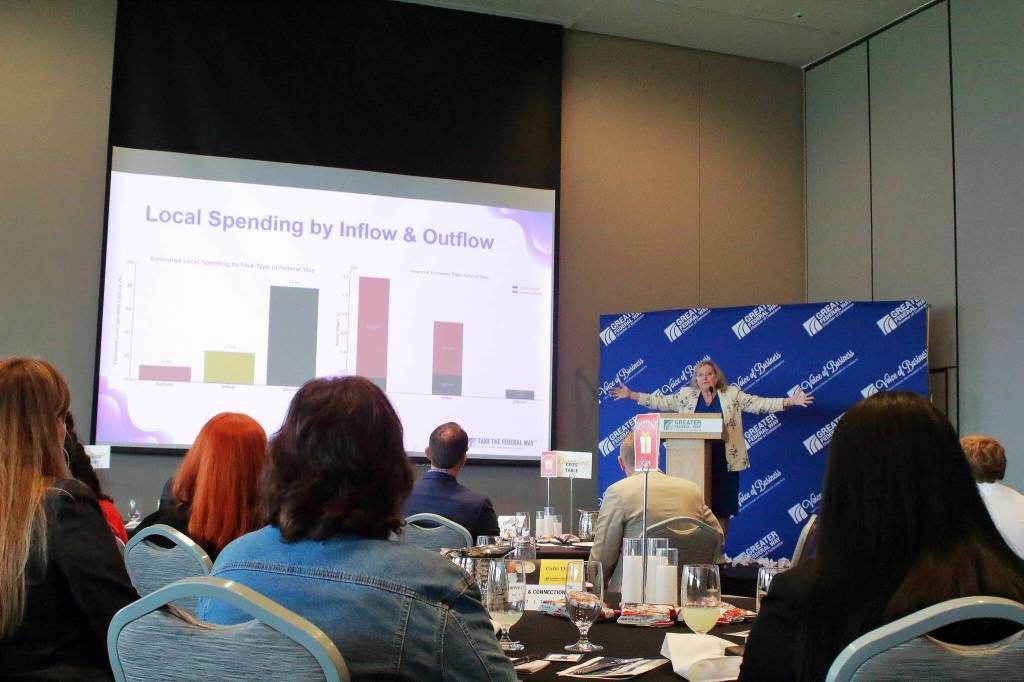
Business retention, talent development and adaptability were highlighted as priorities at this year’s State of the Chamber luncheon by the Greater Federal Way Chamber of Commerce.
The event was held Aug. 6 at the Federal Way Performing Arts and Event Center and centered on insights found in soon-to-be released reports and how the ACCE’s Horizon 2035 can guide goals in Federal Way. The Horizon 2035 report comes from the Association of Chamber of Commerce Executives and is the latest iteration of the guiding materials released once a decade.
Every 10 years, the Association of Chamber of Commerce Executives puts together a report to help guide individual chambers to the future.
Chamber President and CEO Rebecca Martin shared highlights from this report and assessments and recommendations by their contracted consultants to guide Federal Way’s future.
The Horizon 2035 report highlighted three spheres of influences, starting with linchpin influences to describe the most vital forces in a chamber. These important linchpins describe how chambers can act as catalytic leaders and how they can create and accentuate a culture of belonging and gathering.
In Federal Way, Martin reflected on the role of chambers in driving connection and social bonds.
“Twenty percent of the world’s employees experience daily loneliness,” Martin shared. This matters to the chamber because it’s a workforce issue, she said.
“How do you hit your bottom line? How do you focus on what you need to do if you are feeling isolated, disconnected and alone?” Martin asked, but reassured the audience “at this chamber, you are never alone.”
When it comes to catalytic leadership, Martin described Federal Way as a place already strong in this area.
“We are a community with an entrepreneurial mindset. I see this passion in our members as they take proactive steps to shape the future instead of simply responding to the actions of others,” Martin said. The Horizon report also highlighted timeless influences, describing how chambers can be sources of cohesion in environments of political and social fragmentation.
In Federal Way, Martin said, “our business leaders represent a variety of political interests, but we share common interests that transcend any kind of political or social differences we may have, like the need for skilled workforce, fair taxation and pro growth regulatory environments.”
In making sure chambers stay timeless, the Horizon report encouraged chambers to assess their own business models and expectations to make sure they are fostering inclusive economic growth and embracing digital transformation and technological innovation.
To make sure Federal Way is staying ahead of factors like recent innovations in AI and longer term trends like adapting to remote or hybrid work, Martin went over some of opportunities for businesses in the city to lean into.
Expanding Federal Way’s identity as a healthcare hub will be detailed in a soon-to-be-published report, and culinary commerce as a growth strategy will be explored in another.
The chamber already publishes updates to online economic dashboards on labor force, skillsets and workforce data, but Martin announced a new job trend analysis will also be joining the annual public sector data report.
One huge opportunity in Federal Way is to expand the number of local people employed by local businesses.
The latest data on the chamber’s economic dashboards show that there are only 3,018 residents of Federal Way who are actually employed within the city.
The rest of the 31,794 workers who live in Federal Way are employed outside the city. Meanwhile 21,139 workers from outside the city commute into city limits to fill the jobs that are available here.
All of this imbalance means that income and potential revenue is leaking out of the city.
“Right now, we are capturing only a fraction of the total earnings that are generated by the workforce, reflecting a structural imbalance in self-containment. So as you know, we’ve been tracking this since 2018 and the pattern is consistent. Our main export is talent, but it needn’t be,” Martin said.
To make sure they have high quality data to assess how to respond to this and other business challenges, the chamber has contracted with the Department of Commerce for years to work with Ernst and Young on a series of research and recommendation projects.
These reports highlight many different opportunities, but some stand-out themes focus on talent and leadership development to make sure Federal Way residents can be qualified for the jobs in Federal Way, business retention and expansion to increase the number of jobs available and placemaking strategies that expand and accentuate the specific culture and offerings within the city.
Martin has branded the chamber’s business retention program strategies as “the PIES advantage,” sharing that “over the past decade, we have discovered that our members’ interests and concerns fall into four categorical topics, Placemaking, Innovation, Economy and Sustainability.”
Housing constitutes another pressure on Federal Way workforce and business growth, with 34.2% of Federal Way residents spending more than one-third of their income on housing.
“Federal Way faces significant housing affordability challenges that mirror broader trends across Washington state and South King County,” Martin said. “The city exemplifies the growing gap between housing costs and earnings that affect working families throughout the region.” To explore the impacts of this topic, a new report will be coming out soon that “examines the current housing condition, compares Federal Way to state regional benchmarks and identifies critical needs for underserved populations and the possibility and opportunities related to expanding workforce housing.”
When it comes to talent development, Martin shared that the chamber is working on new tools to help workers explore career paths through the chamber website, using databases on the job market to guide their own career development to match the business needs of the community.
Leadership development is a specific area of this topic that has been identified by the Horizon 2035 report and by local chamber data.
“As experienced leaders move on, it becomes crucial to cultivate a pipeline of visionary leaders who can address local issues like housing, economic development and sustainability,” Martin said, adding that “I often get calls from businesses and nonprofits saying, ‘Who do you know that wants to serve on a board?’”
“How are we preparing these people for that?” Martin asked. To support this growth, the chamber will be launching a management training program in January.
Overall, the chamber update described a business landscape with a lot of opportunity that also faces pressures from inside and outside the region and community. Chamber members can look forward to new in-depth reports that will be published soon to help guide them, and all business owners and workers can access impactful data through the publicly available dashboards on their website.